
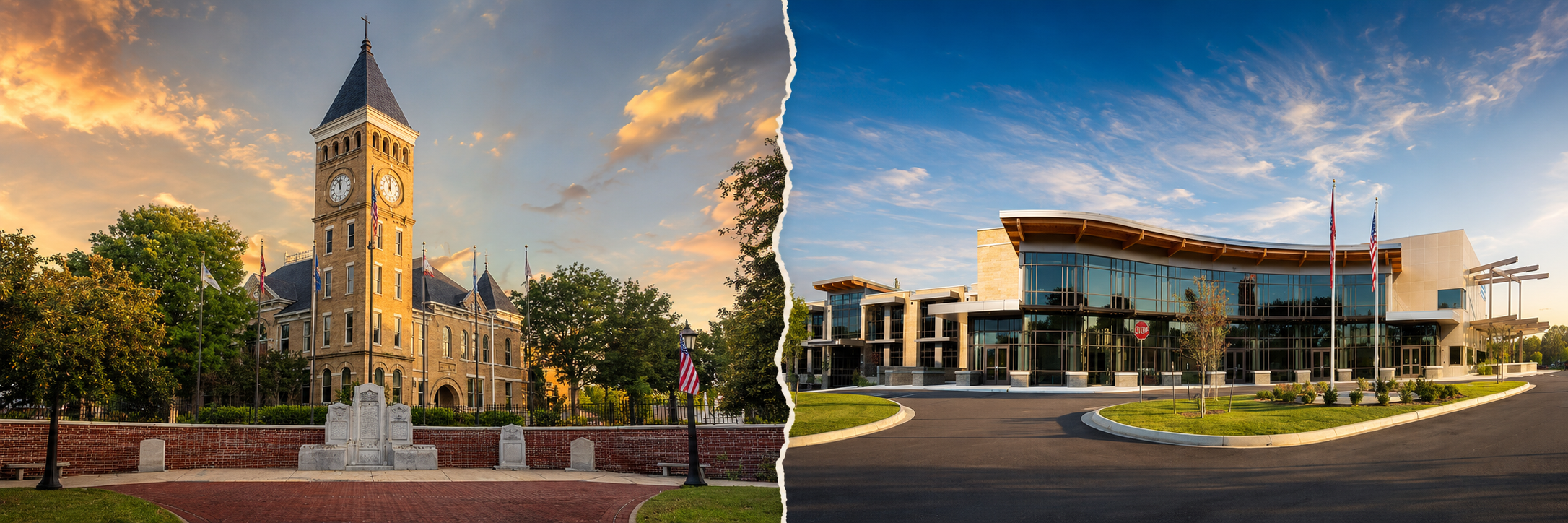
Central Arkansas City Comparison
Benton vs. Bryant, Arkansas
Benton and Bryant sit close together in Saline County, but they do not feel exactly the same. Here is how these two growing Central Arkansas cities compare when it comes to downtown feel, parks, housing, commute, schools, and daily life.
Quick Summary
Benton is the larger city, with a more established downtown, a county-seat identity, historic landmarks, and a wider range of settings across town. Bryant is smaller and more suburban in feel, with much of its day-to-day life centered around neighborhoods, schools, parks, community facilities, and continued growth along the I-30 corridor.
Benton and Bryant are close enough that many people moving to Central Arkansas consider them together. Both sit in Saline County southwest of Little Rock, both are tied closely to the I-30 corridor, and both have seen meaningful growth in recent years.
But they are not the same city.
Benton feels more like a larger, established county-seat city with a historic downtown, older civic identity, and a broader footprint. Bryant feels more like a smaller suburban growth city, with much of its identity tied to neighborhoods, schools, parks, newer development, and long-term planning for what the city becomes next.
If you are comparing Benton vs. Bryant, the better question is not, “Which one is better?” The better question is: Which one better matches the way you want to live day to day?
Benton vs. Bryant at a Glance
| Category | Benton | Bryant |
|---|---|---|
| 2025 population estimate | 38,898 | 22,815 |
| Growth since 2020 estimate base | 11.1% | 10.4% |
| General feel | Larger, more established city | Smaller suburban growth city |
| Center of gravity | Historic downtown, courthouse area, civic core | Neighborhoods, parks, schools, commercial corridors |
| Parks and recreation | Riverside Park, River Center, Tyndall Park, Benton Bike Park, Saline River access | Bishop Park, The Center, Alcoa 40 Park, Mills Park, Midland Park, Springhill Park |
| Housing pattern | Mix of older homes, established neighborhoods, subdivisions, and newer growth areas | Suburban subdivisions, newer residential pockets, and developing corridors |
| Best starting point if you want... | A larger city with a traditional downtown and more historic texture | A suburban setting with strong park and community facilities and continued future planning |
Benton is the larger of the two, with an estimated 38,898 residents in 2025. Bryant’s 2025 estimate is 22,815. Both cities have grown by more than 10% since the 2020 estimates base, so this is not a simple “old city versus growing city” comparison. Both are growing. The difference is how that growth feels on the ground.
Benton and Bryant Are Close, but They Do Not Feel the Same
If you drive between Benton and Bryant, it can be easy to blur the two together. They share regional shopping patterns, commute routes, restaurant traffic, youth sports schedules, and the general rhythm of Saline County growth.
But once you spend time in each city, the difference becomes easier to see.
Benton has the older civic framework. It has the county-seat identity, the courthouse area, downtown buildings, older streets, established neighborhoods, and historic landmarks that give the city a more traditional town-center feel. Benton began as a settlement in 1833, was formally chartered in 1836, and its original layout included a public square and streets.
Bryant is not without history, but its modern identity feels more closely tied to suburban growth. Its day-to-day experience is shaped by residential neighborhoods, parks, schools, and commercial access along busy corridors. The city is also actively thinking about what comes next through planning efforts around neighborhoods, transportation, parks, development, infrastructure, and city services.
That is the heart of the comparison. Benton feels more anchored by what it has been. Bryant feels more defined by what it is becoming.
The I-30 Corridor Shapes Both Cities
For most people comparing Benton and Bryant, I-30 is part of the conversation.
Both cities sit southwest of Little Rock, and I-30 is the main route connecting Saline County to the larger Central Arkansas metro. Exact drive times depend heavily on the address, time of day, road construction, and whether you are headed to downtown Little Rock, West Little Rock, the airport, North Little Rock, or another part of the region.
Bryant is closer to Little Rock geographically, so for some commutes it can offer a shorter drive. Benton sits slightly farther down the corridor, but it also has a larger footprint and more of its own civic and commercial identity. For someone who wants to be close to Little Rock but still spend much of everyday life in Saline County, both cities can make sense.
The bigger issue is not just distance. It is how each city handles growth.
In Bryant, transportation and future development are major parts of the city’s planning conversation. The city’s planning resources include documents tied to the Heart of Bryant, Midtown Bryant, subdivision regulations, zoning, and a Walk, Bike, Drive Bryant transportation plan.
Benton is also planning around long-term growth. The city’s comprehensive plan is intended to help guide development over a 20-year period and addresses land use, transportation, community facilities, parks, roadways, and future land use.
That matters for buyers because Saline County is not standing still. Roads, development patterns, schools, parks, and commercial areas will continue to shape what it feels like to live here.
Benton: A Larger City With Historic Downtown Character
Benton is the better starting point if you want the city with the stronger traditional downtown identity.
Downtown Benton has older buildings, local businesses, courthouse-area streets, and historic landmarks that give the city a sense of place. The Royal Theatre is one of the most recognizable examples. Built in 1920, the two-story brick building served as a movie theater until the 1990s and now operates as a live theater venue for the Royal Players. It remains one of Benton’s most visible downtown landmarks.
Benton also has the Historic Shoppach House on North Main Street, built in 1853 and described by the city as the first brick house constructed in Saline County.
That kind of historic texture changes the way Benton feels. You still have suburban neighborhoods, commercial corridors, and new growth areas, but Benton has a more obvious civic center. If you like a place where the downtown, courthouse area, older homes, and local history are part of the city’s personality, Benton has more of that feel.
Benton also has a wider range of settings. You can find older areas closer to downtown, established subdivisions, newer residential pockets, and properties farther out toward the edges of town. That variety is part of the appeal, but it also means the exact location matters. “Benton” can describe very different day-to-day experiences depending on the neighborhood and commute route.
Bryant: A Smaller Suburban City Still Shaping Its Center
Bryant has a different feel. It is not built around a courthouse square in the same way Benton is. Instead, Bryant feels more like a growing suburban city where much of life revolves around neighborhoods, schools, parks, church campuses, sports, and quick access to nearby commercial corridors.
That does not mean Bryant lacks identity. It just has a different kind of identity.
Bryant’s current planning language points directly to that growth story. The Bryant Leap Forward Comprehensive Plan is described as a community-driven roadmap for decisions about neighborhoods, transportation, parks, development, infrastructure, and essential services.
The city is also working with planning concepts like the Heart of Bryant and Midtown Bryant, which suggests Bryant is still shaping what its future centers of activity will look like.
For a buyer or relocator, that matters. Bryant may appeal more if you want a smaller suburban city with convenient access, active growth, and a strong emphasis on residential life and community facilities. It may feel less historic than Benton, but it can feel more immediately suburban and compact, depending on where you live.
Parks and Recreation: Benton’s Civic Park Campus vs. Bryant’s Park Network
Both cities have strong recreation options, but the experience is different.
Benton’s Riverside Park is one of the city’s major civic recreation hubs. It includes the Senior Activity Center, River Center, Boys & Girls Club, soccer fields, softball fields, baseball fields, and paved walking trail access.
Benton also has Tyndall Park, Sunset Lake, Lyle Park with Saline River access, and the Benton Mountain Bike Park, which includes more than four miles of trails.
That gives Benton a nice mix of indoor recreation, sports fields, walking trails, river access, biking, fishing, and traditional park spaces. It also reinforces Benton’s broader city feel. Recreation is not limited to one park or one part of town.
Bryant’s parks are more network-oriented. The city lists Alcoa 40 Park, Ashley Park, Bishop Park, Midland Park, Mills Park, and Springhill Park among its park locations.
The Center at Bishop Park is the major standout. It is a 75,000-square-foot community center with multi-purpose courts, fitness areas, an indoor cushioned walking trail, event rooms, the Senior Adult Center, and the Bryant Boys & Girls Club. It is also connected to the Aquatic Center and seasonal splash pad.
The practical takeaway is simple: Benton has a larger, more varied park and outdoor recreation picture, especially when you include the Saline River, bike park, and historic park spaces. Bryant has a very strong suburban recreation anchor with Bishop Park and The Center, plus neighborhood park options spread around the city.
Daily Errands, Restaurants, and Local Stops
This is where the comparison gets a little less clear-cut because Benton and Bryant share a lot of the same regional orbit. Many residents in one city will drive into the other for restaurants, shopping, services, school events, sports, or errands.
Benton has the stronger downtown-local-business angle. If you like the idea of local restaurants, shops, historic buildings, and events connected to a recognizable downtown area, Benton has more of that structure already in place.
Bryant’s convenience feels more suburban. Daily errands are often tied to major roads, commercial centers, and quick access points rather than a single historic downtown. That can be a good thing if what you value most is practical convenience: groceries, services, schools, parks, and a short drive to other parts of the metro.
In real life, many people do not choose between Benton and Bryant based on restaurants alone. They choose based on neighborhood, commute, schools, price point, home style, and which daily routine feels easier.
Homes and Neighborhoods: The Exact Location Matters More Than the City Name
This is where buyers need to be careful.
It is tempting to say “Benton is this” and “Bryant is that,” but both cities include a mix of housing and neighborhood types. The city name alone does not tell the whole story.
In Benton, you will generally see more older homes closer to the downtown and established parts of town, along with traditional subdivisions, newer neighborhoods, and homes farther out toward the edges of the city. Benton’s larger footprint creates more variety, but it also means buyers should pay close attention to the exact address and what is nearby.
In Bryant, the housing pattern often feels more suburban, with subdivisions, newer residential areas, and neighborhood streets connected to schools, parks, and commercial corridors. Bryant’s growth pattern can be appealing if you like a newer suburban setting, but the same rule applies: the exact neighborhood matters more than the city label.
Two homes with a Benton address can feel completely different. The same is true in Bryant. One may be closer to I-30. Another may feel quieter and farther from the commercial corridors. One may have easier access to schools or parks. Another may have a better route to Little Rock, depending on your work location.
Before narrowing your search, compare the actual neighborhood, commute pattern, school zone, lot size, age of the home, and nearby road access.
Schools: Check the Address, Not Just the City
Schools are one of the biggest reasons buyers compare Benton and Bryant, but this is also where it is important to slow down and verify details.
Do not assume that every home with a Benton or Bryant mailing address automatically feeds into the school you expect. School assignments can vary by address, grade level, and district boundaries.
Bryant Public Schools notes that students in grades K-7 are assigned to schools based on home address. Benton School District also provides school-zone information and directs families to its school-zone locator for current zone information.
The safest approach is to check the specific property before making decisions around schools. That is true in Benton, Bryant, and really anywhere in Central Arkansas.
So, Should You Choose Benton or Bryant?
Benton may be the better starting point if you want a larger city with a more traditional downtown, more visible local history, a county-seat feel, and a wider variety of settings within the same city.
Bryant may be the better starting point if you want a smaller suburban city with strong park and community facilities, convenient access along the I-30 corridor, and a city that is actively planning around future growth.
But for most buyers, the final decision will come down to the specific home and neighborhood.
A house near downtown Benton, a newer subdivision in Benton, a neighborhood near Bishop Park in Bryant, and a home near the edge of either city may all create very different versions of living in Saline County.
The best move is to compare Benton and Bryant at the city level first, then narrow the search by neighborhood, commute, school zone, home style, and the places you expect to visit most during a normal week.
FAQ: Benton vs. Bryant, Arkansas
Is Benton bigger than Bryant?
Yes. Benton’s 2025 Census estimate is 38,898 residents, while Bryant’s 2025 estimate is 22,815 residents. Both cities have grown by more than 10% since the 2020 estimates base.
Is Bryant closer to Little Rock than Benton?
Generally, yes. Bryant is closer to Little Rock along the I-30 corridor, while Benton is slightly farther southwest. Actual commute time depends on the address, traffic, construction, and where in Little Rock or Central Arkansas you are headed.
Does Benton have more historic character than Bryant?
Yes, Benton has the stronger historic downtown and civic identity. Its original town layout included a public square, and downtown Benton includes landmarks such as the Royal Theatre and Shoppach House.
Which city has better parks?
Both have strong recreation options, but they are different. Benton has a broader mix that includes Riverside Park, Tyndall Park, Saline River access, Sunset Lake, and Benton Mountain Bike Park. Bryant has a strong suburban park system anchored by Bishop Park and The Center.
Should I search homes in Benton or Bryant first?
Start with your daily priorities: commute, home style, school zone, neighborhood feel, parks, and access to the places you visit most. Then compare actual neighborhoods rather than relying only on the city name.
Continue Exploring Saline County
Want to compare the area more closely? Start with the full Benton and Bryant city guides, then look at specific neighborhoods, commute routes, and current homes that match the way you want to live in Saline County.
Sources
- U.S. Census Bureau QuickFacts: Benton city, Arkansas
- City of Benton: About Benton
- City of Benton: Comprehensive Plan
- City of Benton: Riverside Park
- Discover Benton: Parks and Recreation
- Discover Benton: Outdoor Activities
- Bryant Leap Forward Comprehensive Plan
- City of Bryant: Planning and Community Development Resources
- City of Bryant: Park Locations
- City of Bryant: The Center at Bishop Park
- Bryant Public Schools: Zoning Information
- Benton School District: Elementary School Zones
Enjoy this blog post? Click here to subscribe for updates
Leave A Comment